

The Old Software
Why our ancient brains still run the show

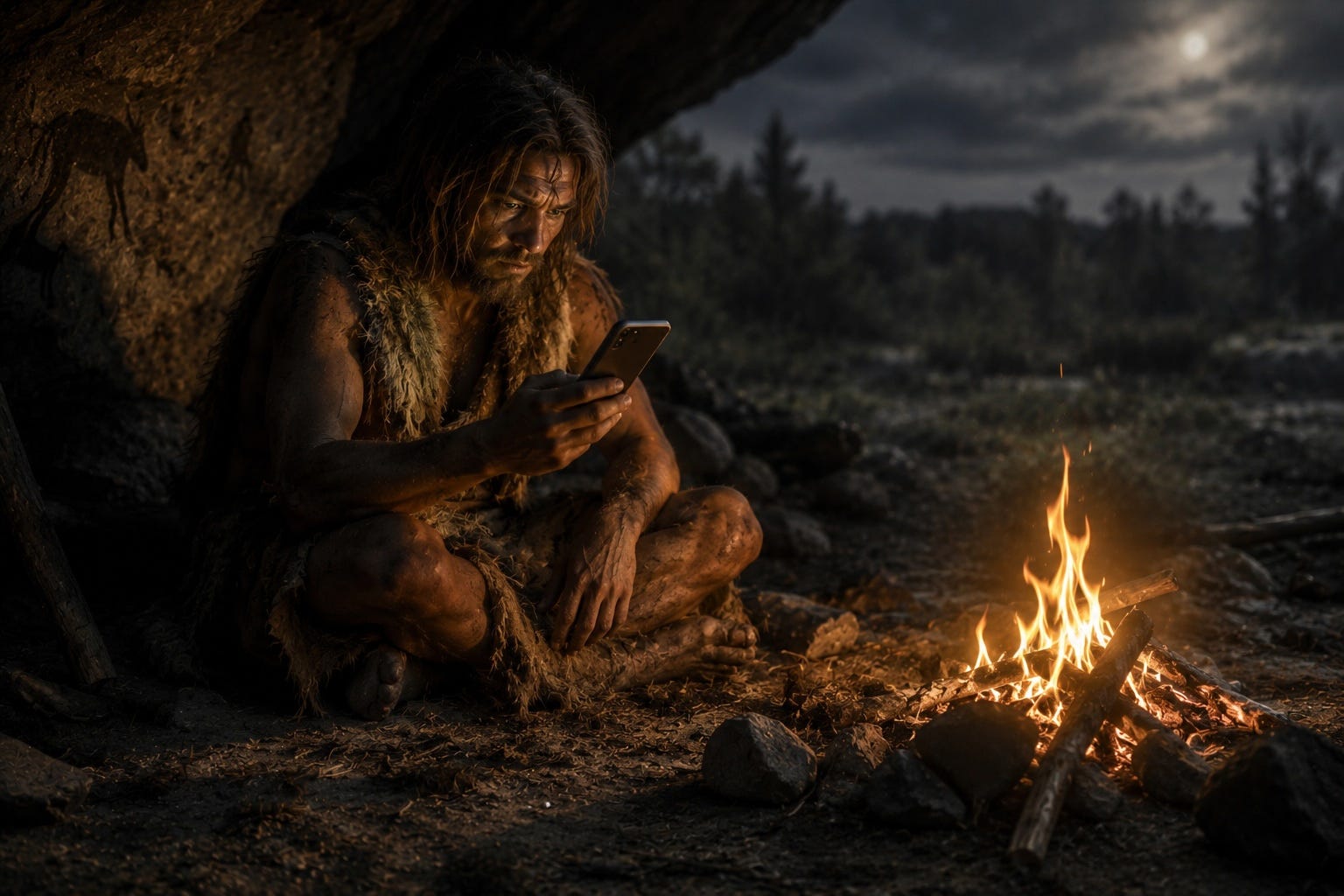
Most of us think our problems are modern, which of course they aren’t. The technology is modern. The operating system - our minds - aren’t.
I was reminded of this recently while reflecting on (and writing about) some of the fears that have shaped my own life. Fear of failure. Fear of rejection. Fear of making the wrong decision. Fear of not being enough. On the surface, these seem like modern concerns. They appear in offices and relationships, on social media and in sports, in house purchases and career changes. Yet I suspect they are far older than that.
For most of human history, survival depended on belonging. Being accepted by the tribe wasn’t simply pleasant; it was essential. To be excluded could mean losing protection, companionship, food and, ultimately, your chances of survival.
The people who paid attention to social threats were more likely to survive long enough to pass on their genes. The result is that many of us still react to social rejection as though our lives depend on it.
A critical comment can feel disproportionately painful. Being ignored can feel threatening. We compare ourselves to others and worry about our place in the world. Our ancestors lived in small tribes. Today the tribe might be an office, a bike club, a friendship group, a social media platform or a WhatsApp chat.
“We have built a twenty-first-century civilisation while running software designed for a much older world.”
The setting has changed, but the circuitry remains remarkably familiar. The same may be true of many of our other struggles. We evolved in conditions of scarcity, where food was uncertain and resources limited. It made sense to gather, store and protect whatever you could. Yet many of us now live in societies of unprecedented abundance while still carrying minds shaped by scarcity. We seek more money than we need. More certainty. More recognition. More control Not because we are broken, but because we are running ancient code.
This isn’t a criticism of humanity. Quite the opposite. These instincts got us here. They helped a vulnerable species survive long enough to build cities, write books, map the genome and walk on the moon. The question is whether the same instincts that helped us survive are always helping us thrive.
When I look at the world, I sometimes wonder whether many of our biggest challenges are not technological at all.
We have extraordinary tools. We can communicate across continents in seconds. We carry access to more information in our pockets than entire generations possessed in a lifetime. We produce enough food to feed billions. And yet we still struggle with tribalism, fear, conflict and short-term thinking.
It’s as though we have built a twenty-first-century civilisation while running software designed for a much older world. Perhaps this is simply the human condition. Or perhaps we are living through a transition.
One of the most remarkable things about being human is that we can become aware of our own programming. We can notice our fears. We can question our assumptions. We can recognise the stories we tell ourselves and decide whether they are still serving us.
“The soul becomes dyed by the colour of its thoughts.” - Marcus Aurelius
Much of personal growth seems to involve exactly this process. We realise that a fear which once protected us is now holding us back. We discover that an old belief is no longer true. We begin to separate what is genuinely wise from what is merely familiar.
I sometimes wonder whether civilisation itself faces a similar challenge. Can a species become conscious of the forces that shaped it? Can we recognise when ancient instincts are driving modern decisions? Can we learn to cooperate at scales our ancestors never needed to imagine?
Perhaps the next stage of our evolution is not biological at all. Perhaps it is the gradual expansion of awareness. The ability to see our impulses without automatically obeying them. The ability to recognise fear without being ruled by it. The ability to widen our circle of concern beyond our immediate tribe.
The deeper challenge has always been the same. To understand ourselves. Because once we can see the old software running, we gain something our ancestors never had.
A choice. And perhaps that choice is where the next chapter of the human story begins.
In aviation I've long referred to logic based on old technology and old knowledge as "legacy thinking." In aviation, this type of thinking can actually interfere with our safety. I really enjoyed reading this piece on how ancient thinking can interfere with our well-being.