

The Lens
Why Two People Can Live in Different Worlds

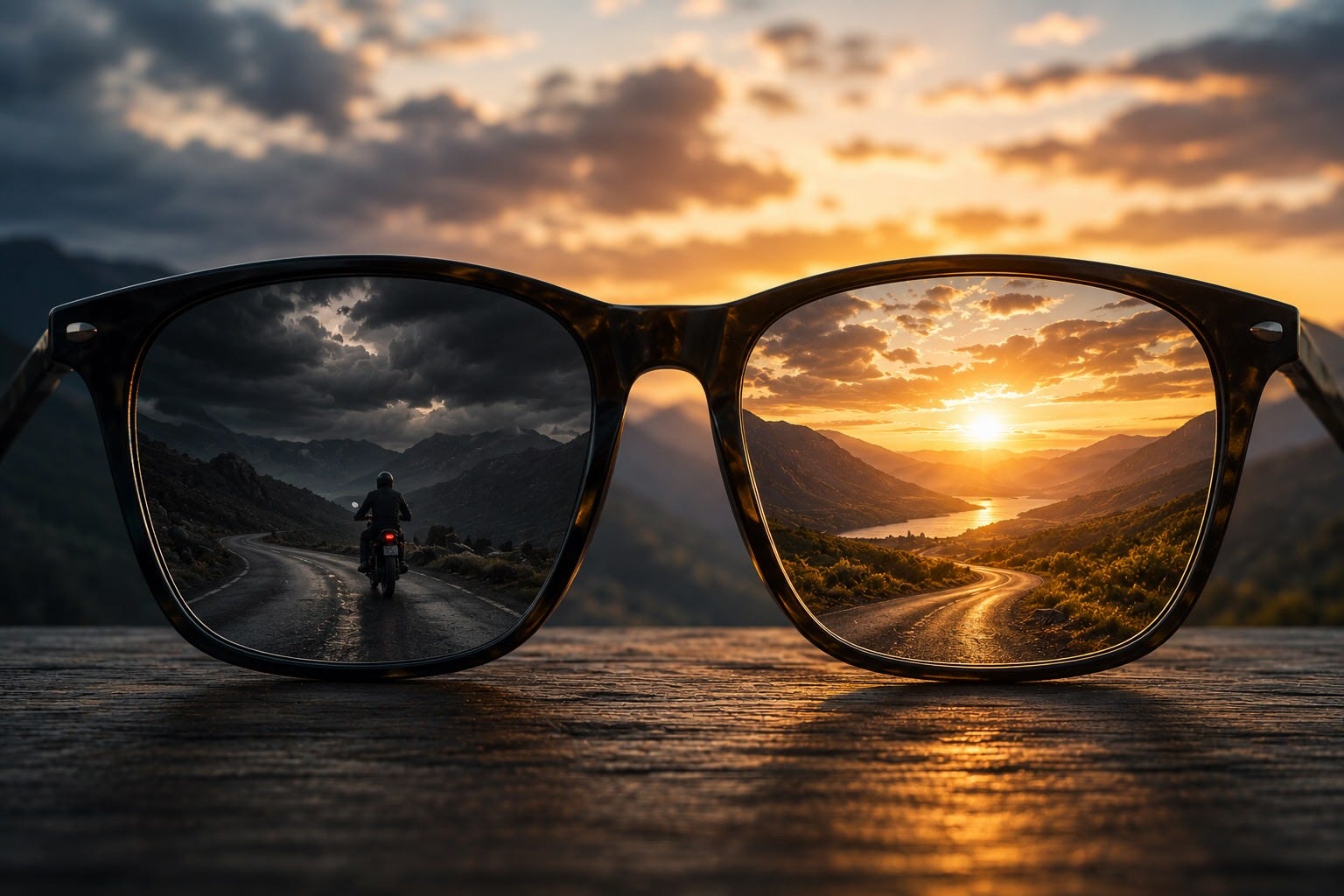
Two people can stand in exactly the same place and see completely different worlds. One sees opportunity. The other sees risk. One sees freedom. The other sees uncertainty. One sees possibility. The other sees all the reasons something might go wrong.
The world itself hasn’t changed. Only the lens through which it is being viewed.
I’ve been thinking about this a lot recently. Like many people, I have found myself wrestling with a decision. Looking at the same set of facts one day and feeling excited by them, then looking at those exact same facts the next day and feeling apprehensive instead.
Nothing external had changed. The house was the same house. The risks were the same risks. The opportunities were the same opportunities. What changed was the lens. Some days I found myself focusing on everything that could go right. The character. The possibility. The life that might unfold there.
Other days I found myself focusing on everything that could go wrong. The cost. The uncertainty. The responsibilities. Neither was the whole picture. And that’s the thing about lenses. We rarely notice we’re looking through them. We assume we’re seeing reality as it is.
Yet our experience of the world is filtered through beliefs, memories, fears, hopes and expectations that we have accumulated over a lifetime. The optimist and the pessimist may be looking at the same horizon. They are not seeing the same landscape. This isn’t necessarily a flaw. It’s simply part of being human.
Our brains evolved to simplify a complex world. We can’t pay attention to everything, so we pay attention to what seems most important. The problem is that what feels important isn’t always what is important.
If you’ve ever bought a new car and suddenly noticed the same model everywhere, you’ve experienced this. The cars were always there. Your attention simply diverted.
The same thing happens with opportunities. And problems. And people. And ourselves.
When we believe we’re capable, we notice evidence that supports that belief. When we believe we’re inadequate, we notice evidence for that too. The lens quietly shapes what enters our awareness.
Looking back, I can see how often my own lens has changed over the years. There was a time when I saw challenge primarily as something to avoid. Then motorcycling entered my life and gradually altered the picture. Challenges became things to lean towards rather than retreat from. Not because I became fearless. Far from it. But because I began interpreting fear differently.
The event stayed the same. The lens changed. Many of the most significant shifts in life seem to happen this way. Not because the world changes overnight, but because our way of seeing it does. The promotion that once felt impossible becomes achievable. The setback that felt devastating becomes a lesson. The stranger becomes a friend. The ending becomes a beginning.
The facts may remain unchanged, but the meaning transforms. Perhaps wisdom is not about finding the perfect lens. Every lens reveals something and obscures something else. Perhaps wisdom lies in recognising that we are looking through one. In pausing long enough to ask: What am I not seeing? What assumptions am I bringing to this situation? What story is shaping my view?
Because the moment we become aware of the lens, we gain a little more freedom. Freedom to question it. Freedom to adjust it. Freedom to choose where we place our attention. And as we’ve explored throughout this series, attention matters.
Because where you look is where you go.
Relatively isn't just about physics.