
Fear as a Compass
Why fear is useful as a messenger, but dangerous as a master

Fear is not the enemy. I think we sometimes talk about fear as if the aim is to get rid of it completely, but I’m not sure that would be wise. Fear is useful. Fear is information. Fear is the part of us that says, “Pay attention. There may be something here you need to look at.” And sometimes it is absolutely right. Don’t jump off a moving train. Don’t ignore the strange noise coming from the engine. Don’t assume the large angry dog is simply misunderstood and in need of a cuddle.
Fear has kept human beings alive for a very long time. It deserves some respect. But it makes a much better servant than master. The problem begins when we let fear make the whole decision before we have even examined what it is trying to tell us.
Because fear is not always accurate. It is not a calm, balanced committee sitting around a table with spreadsheets and biscuits. It is often more like a very dramatic security guard who has had too much coffee. It sees danger everywhere. Failure. Embarrassment. Rejection. Uncertainty. Looking silly. Being judged. Not knowing anyone. Getting it wrong. And because fear speaks with such urgency, we can mistake volume for truth.
But fear is not truth. It is a message.
The question is whether we are willing to read it properly.
If fear says, “This is dangerous,” then perhaps the answer is not “don’t do it.” Perhaps the answer is, “What skills do I need? What risk can I reduce? Who can teach me? What would make this safer?” That is a very different conversation. One closes the door. The other asks for a map.
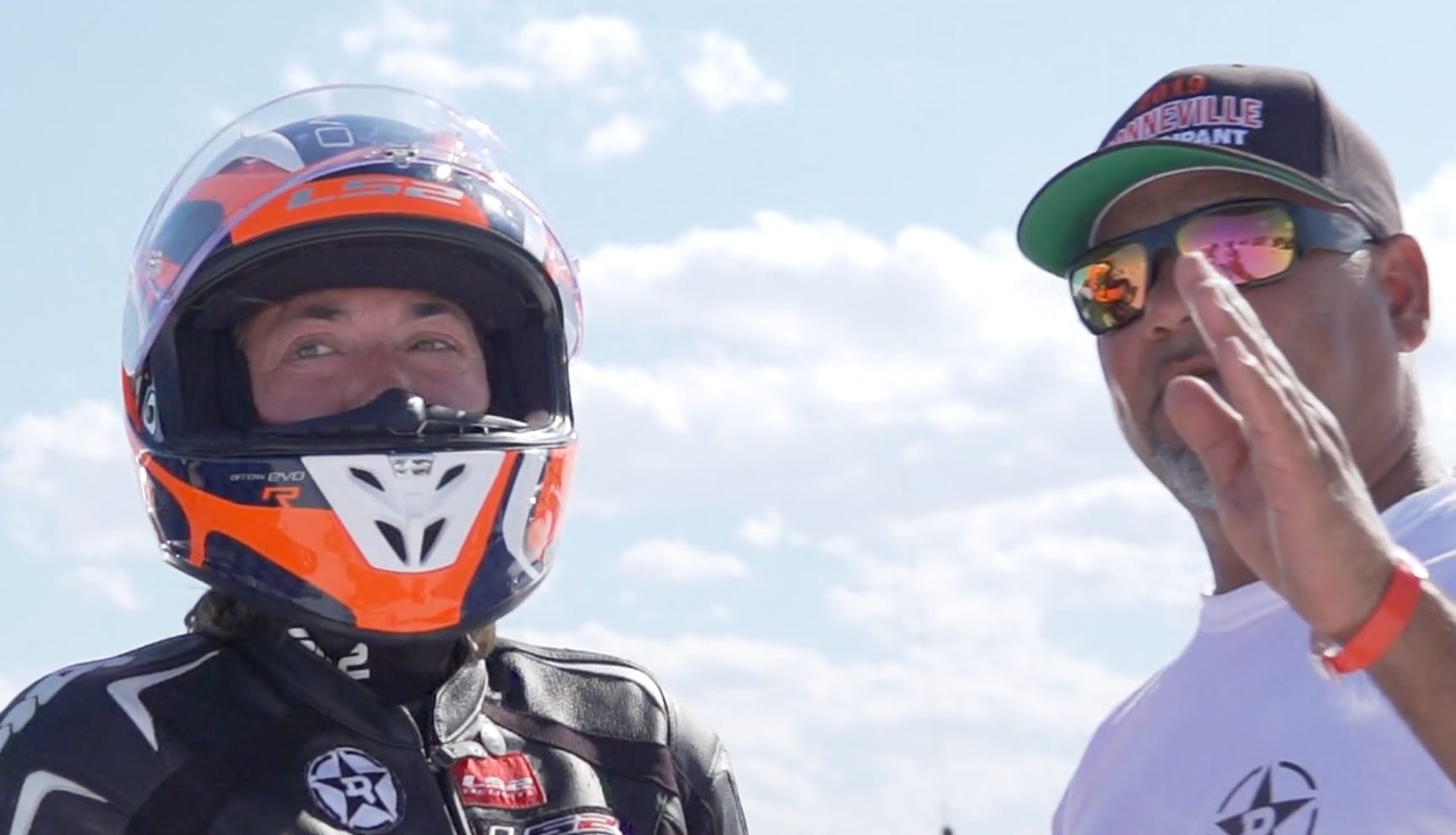
I should know. I was afraid of going fast on a motorbike. Quite reasonably, I think. Speed is not something to be casual about, especially when you are the soft bit sitting on top of the machine. But I didn’t deal with that fear by pretending it wasn’t there. I didn’t just throw myself at it and hope enthusiasm would do the rest. I practised. I learned from good riders. I listened. I visualised myself going faster. I inched the speed up bit by bit until my body and mind began to understand what was happening. The fear didn’t vanish. It changed shape. It became less of a wall and more of a signal.
That, to me, is the important distinction. Fear can stop you, or it can train you.
It can say, “No, never.” Or it can say, “Not yet. Learn more. Prepare better. Build the capacity.” One keeps you small. The other helps you grow.
And this applies to far more than motorbikes. It applies to walking into a room where you don’t know anyone. Starting again. Sending the message. Publishing the piece. Taking the class. Saying yes to something that feels just beyond the edge of who you currently believe yourself to be. Fear often appears at the border between the familiar self and the possible self. It stands there waving its arms, insisting you turn back.
Sometimes it says, “You’ll look silly if this doesn’t work.” Sometimes it says, “That’s not who you are.” Sometimes it says, “People like you don’t do things like this.” And that is where we have to be very careful, because fear can sound remarkably like common sense when it is really just protecting an old identity.
This is where “where you look is where you go” comes in again. If all your attention goes to what might go wrong, your world narrows around threat. You begin to see only the reasons not to act. You collect evidence for staying exactly where you are. But if you look at fear more carefully, if you ask what it is pointing towards rather than what it is shouting about, something changes. Fear becomes a compass. Not because it always points to danger, but because it often points to meaning.
The things we fear are often the things that matter to us.
Not always, of course. Sometimes fear points to an actual cliff edge, and it is probably best not to interpret that as a spiritual invitation. But often, especially in ordinary life, fear rises because something matters. Because there is a risk of failure. Because there is a possibility of change. Because some part of us knows that if we do the thing, we may not be able to go back to being quite the same person afterwards.
That is why regret is such a useful question.
If you are afraid of doing something, imagine not doing it. Not just tomorrow, but years from now. Imagine the life where you turned away because it felt safer. Does that bring relief? Or does it bring a quiet ache? If the thought of not doing it fills you with regret in advance, then perhaps fear is not telling you to stop. Perhaps it is telling you this matters.
And then the work is not to be fearless. I don’t really trust fearless. Fearless can be reckless. Fearless can be daft. Fearless is how people end up on the evening news with the phrase “seemed like a good idea at the time” hovering in the background.
The work is to become skilled in the presence of fear. To reduce the risk where you can. To prepare. To ask for help. To practise. To make the danger smaller without making your life smaller too.
Because all life contains risk. Love contains risk. Change contains risk. Staying still contains risk as well, although we often forget that because it looks quieter from the outside. There is a risk in doing the thing, yes. But there is also a risk in never doing it. A risk that life becomes narrower. A risk that you become very good at protecting yourself from experiences you secretly wanted to have.
Hamlet says, “There is nothing either good or bad, but thinking makes it so.” I think about that often. Not because every fear is imagined, but because our interpretation of fear changes everything. One person feels fear and decides it means “stop.” Another feels fear and decides it means “prepare.” Another feels fear and decides it means “this is where the work is.”
Same feeling. Different road.
So perhaps the question is not, “How do I stop being afraid?” Perhaps the better question is, “What is this fear asking of me?”
Is it asking me to pause? To prepare? To learn? To listen? To walk away? Or is it asking me to grow into the kind of person who can meet this moment without being ruled by it?
Fear is useful. Listen to it. Thank it, even. But don’t hand it the keys and let it drive your whole life.
Let it point. Let it warn. Let it sharpen your attention.
Then decide for yourself where you’re going.
I totally agree. I don't ride as much "off road" as I used to and my comfort zone has changed. Out last week I debated whether to do a particularly steep and rough descent. Missing it out would mean a long tarmac diversion but I knew the ride would challenge me.
Can I do this? Yes.
Have I done so before? Yes, many times.
Do I have a good idea what it will be like? Yes.
Might I come off? Yes but I will be going slowly and my protective clothing is good.
Is it remote? Not particularly.
Is it worth doing? Definitely.
So, I did it. I needed to stop and reassess at one point. I stayed upright. I succeeded in raising the level of my comfort zone a few degrees.
I can think of many other areas of life where similar has happened.
Go for it, but wisely.